Escape from theory land
Christophe Godfroid · Reality land, not theory land
This is not a series about AI technology.
This field moves faster than any book can follow. Read these volumes now: the decisions they describe are being taken this year, with you or without you.
What this series is about
Everything in it comes from doing that work, not from theory.
It is about what happens when an organisation tries to adopt AI for real: the foundations it needs, the rules it has to rewrite, the people who have to change how they work, and the leaders who have to decide. Everything in it comes from doing that work, not from theory. The stories may sound like successes. They are what remains after many experiments, some failures and several abandoned projects.
theory land
It is what I call governance from theory land: rules for autonomous agents written while people are still learning to edit AI drafts, before anyone had the experience to write them well.
reality land
This series shares his passion, his knowledge and his experience from the floor. From reality land, not theory land.
Each volume stands on its own and opens with a one-page summary of the map.
The books
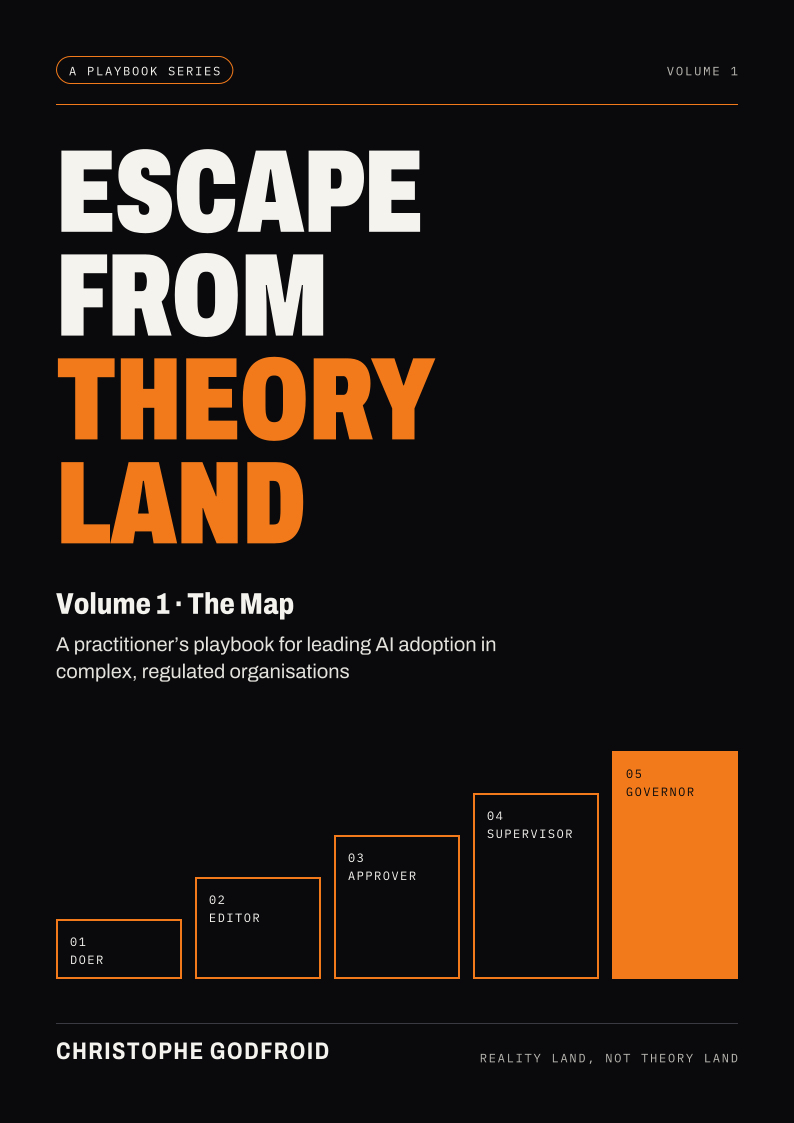
The Map
A practitioner’s playbook for leading AI adoption in complex, regulated organisations
For leaders who decide. What is happening, and what only leaders can decide.
Open the site Volume 2 · 116 pages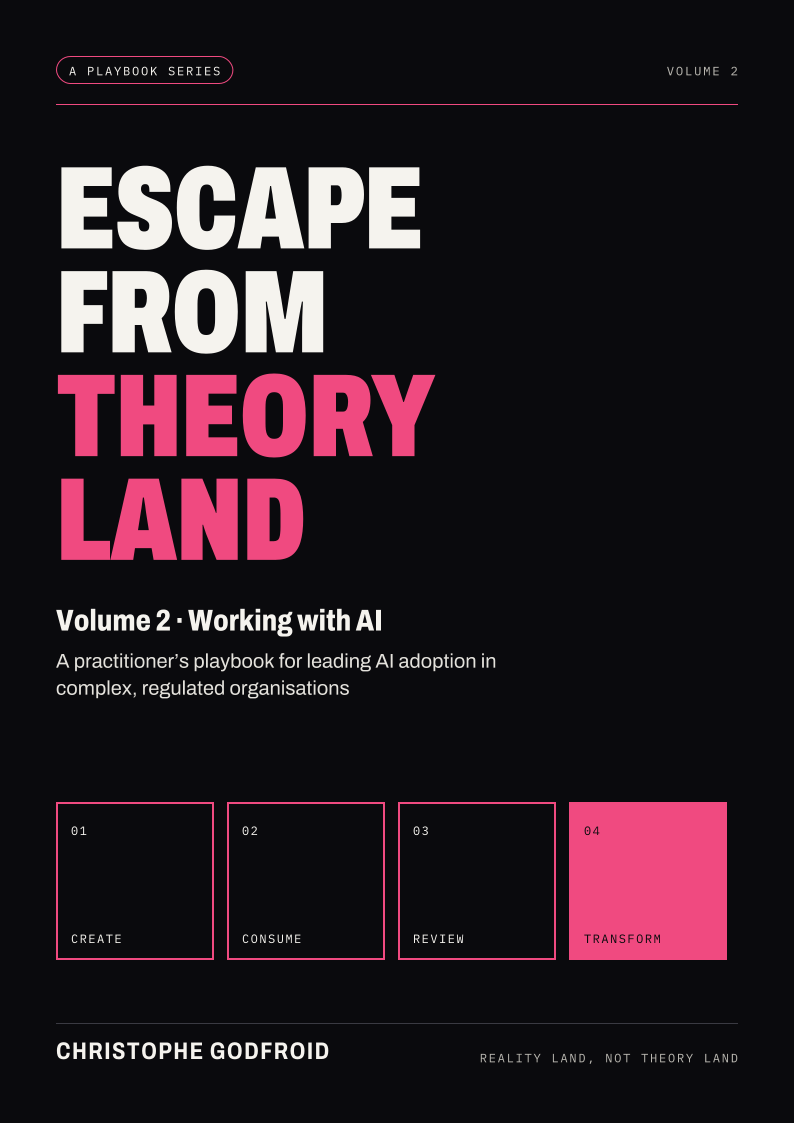
Working with AI
How knowledge work changes: create, consume, review, transform
For managers, team leads and champions. How people get real value from AI, and what it costs them.
Open the site Volume 3 · 128 pages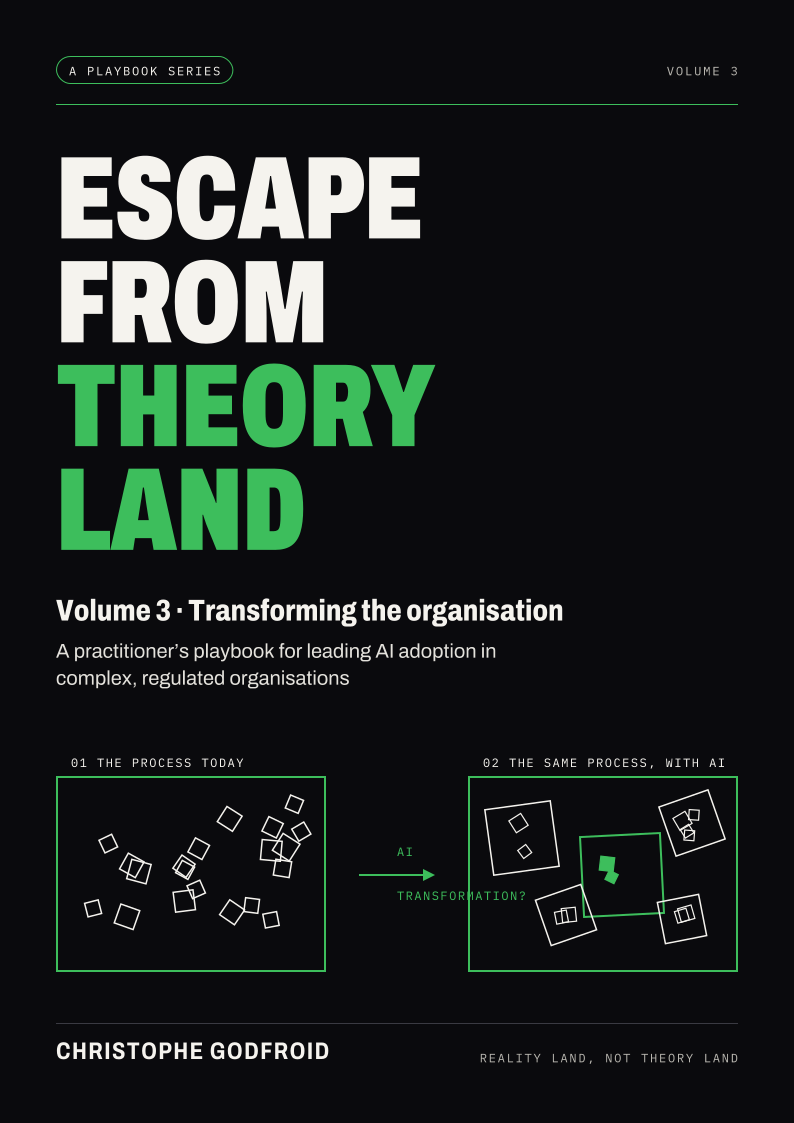
Transforming the organisation
From using AI to redesigning the work
For transformation leads, process owners and engineering leaders. How to move from individual gains to changed processes, safely.
Open the site Bonus pack #1 · 85 pages
Beyond the Chat
A practitioner's guide to long projects with Claude, for non-developers
Give the project a memory that you own and that Claude can read.
Open the siteHow these sites work
Each site follows one book. As you scroll, the book's central picture builds itself one piece at a time, in the book's own words, with a pointer to the chapter and pages where you can read more.
The sites explain. The books go deeper.
Why I don’t hide my use of AI
AI makes possible, for one person, what used to need a team.
Look at this playbook. Writing, reviewing, illustrating, laying out and publishing it would once have needed several people, each bringing different skills. I could never have found or paid for all of them, so I would never have written it. AI let me do it largely on my own. That is the pattern: AI makes possible, for one person, what used to need a team.
Not because AI wrote the message, but because I want people to know I use it. Most people still treat AI as something to hide, as if working with a machine made their work worth less. I believe the opposite. Soon, not knowing how to use these tools responsibly will look stranger than using them.
How this playbook was made
This playbook is grounded in my own experience on the floor: more than fifty articles I wrote over two years, discussions with peers at conferences, hours of early-morning brainstorming with AI companions and cups of coffee, real refusals and real mistakes. Books helped me name what I was seeing, Ethan Mollick’s Co-Intelligence first among them. The lessons come from doing the work.
What came from me
The experience, the convictions and the stories. Every decision about what to keep, cut or change. Every page reviewed line by line, often several times. The final word on every sentence.
What the AI did
Claude helped me structure the material, spot the contradictions between my own writings, draft each chapter from my notes, check the facts and lay out the pages. It also disagreed with me, more than once, and some of those disagreements made the book better.
The influences are acknowledged. The opinions are mine, and so are the mistakes.